
EDOMIND / KNOWLEDGE / PHD THESIS
k-SCAS: A Knowledge-Driven Framework for the Specialty Coffee Agribusiness System
PhD Thesis · Engineering and Knowledge Management
Federal University of Santa Catarina · 2021
RESEARCH · PHD THESIS · 2021
The knowledge behind specialty coffee
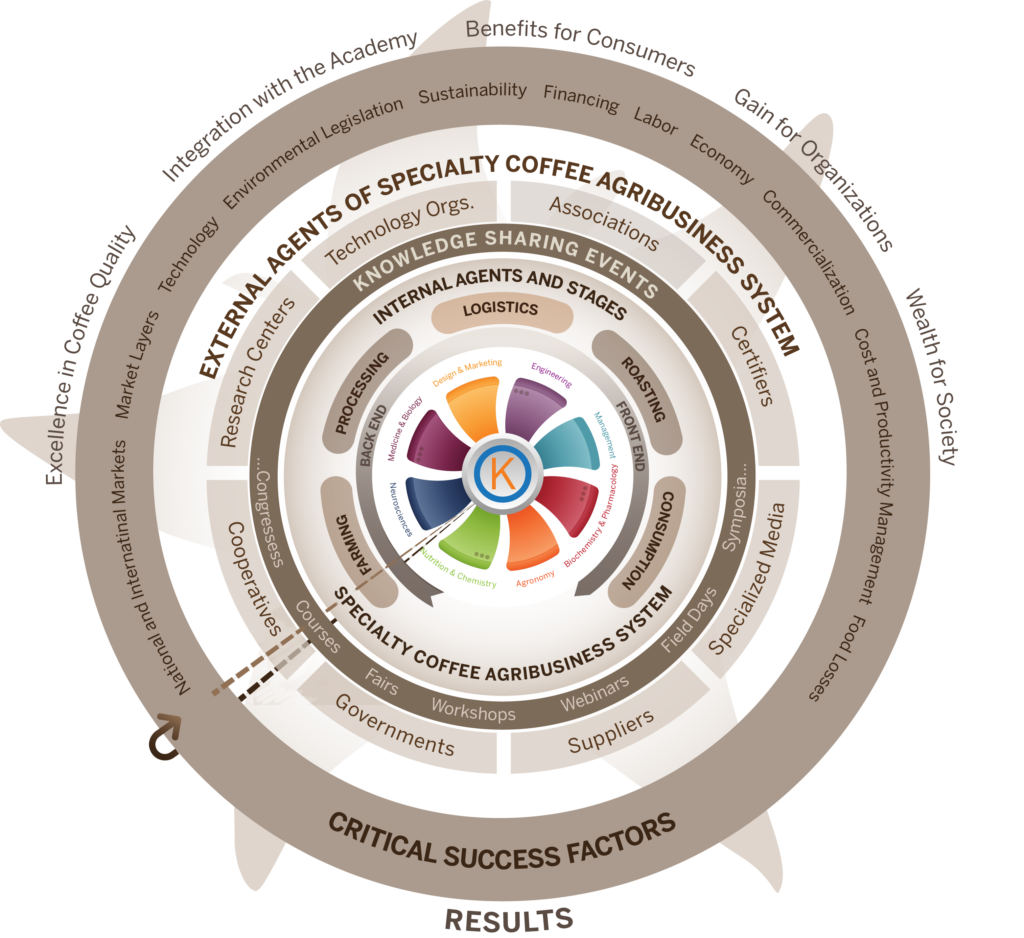
What knowledge is essential to preserve specialty coffee quality from seed to cup? My doctoral research explores this question through k-SCAS, a conceptual framework that represents the Specialty Coffee Agribusiness System from a knowledge-driven perspective. Developed at the Federal University of Santa Catarina, the framework provides an integrated view of the system’s actors, stages and essential knowledge, supporting decisions aimed at achieving excellence in the final product.
Awarded Best Thesis in Knowledge Engineering · 2022
Award conferred by the Postgraduate Programme in Knowledge Engineering, Management and Media at the Federal University of Santa Catarina.
EDUARDO TRAUER · FEDERAL UNIVERSITY OF SANTA CATARINA · 2021
A knowledge-driven view of specialty coffee
The coffee sector constitutes one of the most important sectors of the world economy, with market figures in excess of US$ 430 billion. Despite being an apparently simple product for consumers, the transformation from seed to cup involves knowledge-intensive processes in several interconnected stages and the involvement of countless agents. There are several quality standards for the final product, one of which is the so-called specialty coffees that seek to preserve the best properties of coffee. Many activities are developed in isolation by agents in the sector who lack in-depth knowledge of how the product of each stage will be transformed and consumed in subsequent stages. In this context, arise the issues that underlie this thesis: 1) complexity and particularities of the Specialty Coffee Agribusiness System (SCAS); 2) relevance of identifying and representing essential knowledge for SCAS agents; and 3) the need to maintain maximum coffee quality in the SCAS. Therefore, the objective of the thesis is: To propose a conceptual framework to represent the Specialty Coffee Agribusiness System, focused on knowledge-driven at the best quality of the final product. For the development of this research, we opted to use Design Science Research (DSR), characterizing this thesis as technological research according to Design Science. During the six stages specified in DSR, different methods and techniques were used, including: bibliographic research, systematic integrative review, surveys, semi-structured interviews, thematic analyses, text mining techniques, knowledge representation and visualization of information and knowledge. The survey with SCAS agents obtained 369 valid responses from agents in 41 countries. This enabled identification and representation, through domain ontologies and knowledge graphs, of the sources of knowledge and the knowledge considered essential by agents to obtain specialty coffee. In this part of the research, it was necessary for agents to interact and learn about other stages of SCAS as well as to demonstrate an interest in the traceability of coffee from the seed to the final consumer. In addition, the survey generated proposals for the enrichment of the k-SCAS Framework (Knowledge-Driven – Specialty Coffee Agribusiness System), making it more robust for the verification phase with specialists. Verification of the proposed framework with specialists, showed that it has theoretical elements and a logic of representation consistent with those of the specialists. In this phase, the need for agents to know the other stages and have an integrated view of SCAS to plot their actions emerged. Furthermore, in the verification with specialists, a practical application of the framework was suggested, related to its potential to allow a holistic view of Knowledge-Driven SCAS. The practical application refers to the construction of Knowledge-Driven Proto-Personas by SCAS agents and their journey maps to facilitate strategic decisions by both internal and external agents of the system. Finally, we conclude that the k-SCAS Framework presents a useful contribution to guide researchers and agents of SCAS in decisions that aim to achieve excellence in coffee quality. This contribution, in turn, is unique, as it encourages the integration of previously disciplinary knowledge in the agribusiness sector of specialty coffees, showing the importance of integrating agents (internal and external) and stages of this system that can be adapted to other sectors of agribusiness. The k-SCAS Framework may serve as a foundation for the development of a Meta-Framework for a Knowledge-Driven Agribusiness System.
Keywords: Knowledge-Driven. Specialty Coffee. Agribusiness. Knowledge Representation. Quality. Essential Knowledge.
Abstract
This study investigates, through the lens of the Knowledge Management 5.0 (KM 5.0) paradigm, the role of Generative Artificial Intelligence (GAI) as a partner in the co-creation of knowledge for the development of proto-personas within the context of data-driven marketing. The research addresses the challenge of understanding consumer behaviour in niche markets – in this study, the bonsai market – which are characterised by a scarcity of structured data and a predominance of tacit context. An applied qualitative approach was adopted, with an exploratory-descriptive design. The study was conducted with 71 undergraduate students (67 valid responses; response rate of 94.4%) enrolled in Marketing courses at ESAG/Udesc. Participants interacted with a Generative Artificial Intelligence Agent (GAIA) named John Jobs Naka (J. J. Naka), configured using a specialised corpus derived from in-depth qualitative interviews with recognised sector experts, together with technical publications and secondary data. The methodological framework was structured on the SECI model (Socialisation, Externalisation, Combination and Internalisation) to enable the analysis of knowledge conversion processes in human-AI interaction. The findings demonstrate that GAIA can function as a cognitive mediator, facilitating the externalisation and integration of knowledge while supporting the development of proto-personas as strategic marketing artefacts. The quantitative results indicate high levels of acceptance and perceived utility – 98.5% of participants recognised the agent as an effective partner; the clarity score was 4.19/5; and recommendability 8.57/10. Qualitative analysis highlights three key aspects: cognitive mediation, empathy and humanisation (aligned with H2H marketing), and epistemological integration of tacit and explicit knowledge. This cutting-edge study represents an advancement of KM 5.0 by demonstrating the capacity of GAIA to enhance learning processes, support agile knowledge development and enable the generation of sophisticated consumer insights in niche markets. The findings also have relevant implications for the fields of marketing and higher education, positioning GAIA as scalable tools for the co-creation of knowledge while preserving human centrality in decision-making processes.
Keywords: Generative Artificial Intelligence Agent; Knowledge Co-creation; Proto-personas; Data-driven marketing; KM 5.0.
Publication details
Author: Eduardo Trauer
Original title: k-SCAS: framework do sistema de agronegócios de cafés especiais orientado ao conhecimento
Document type: PhD Thesis
Degree: PhD in Engineering and Knowledge Management
Institution: Federal University of Santa Catarina — UFSC
Programme: Postgraduate Programme in Engineering and Knowledge Management
Supervisor: Prof. Dr Eduardo Moreira da Costa
Co-supervisor: Prof. Dr José Leomar Todesco
Place and year: Florianópolis, Brazil · 2021
Extent: 304 pages
Language: Portuguese
Award: Best Thesis in Knowledge Engineering — awarded by the Postgraduate Programme in Knowledge Engineering, Management and Media, UFSC, in 2022.
Cite this research
ABNT
TRAUER, Eduardo. k-SCAS: framework do sistema de agronegócios de cafés especiais orientado ao conhecimento. 2021. 304 p. Tese (Doutorado em Engenharia e Gestão do Conhecimento) – Universidade Federal de Santa Catarina, Florianópolis, 2021. Disponível em: https://repositorio.ufsc.br/handle/123456789/227021. Acesso em: 12 out. 2026.
APA
Trauer, E. (2021). k-SCAS: Framework do sistema de agronegócios de cafés especiais orientado ao conhecimento[Doctoral dissertation, Universidade Federal de Santa Catarina]. Repositório Institucional da UFSC. https://repositorio.ufsc.br/handle/123456789/227021
Harvard
Trauer, E. 2021. k-SCAS: framework do sistema de agronegócios de cafés especiais orientado ao conhecimento. [Online]. PhD thesis, Universidade Federal de Santa Catarina. [Accessed 12 October 2026]. Available from: https://repositorio.ufsc.br/handle/123456789/227021
PHD THESIS · k-SCAS
Knowledge across the specialty coffee system
The k-SCAS framework provides an integrated representation of the Specialty Coffee Agribusiness System, bringing together its actors, stages and the knowledge essential to preserving coffee quality.
Beyond this central objective, an additional contribution emerged: the application of knowledge-driven proto-personas in marketing. This became the starting point for my subsequent research into proto-personas for market understanding and marketing strategy.
The thesis received the Best Thesis Award in Knowledge Engineering in 2022, conferred by the Postgraduate Programme in Knowledge Engineering, Management and Media at the Federal University of Santa Catarina.
An integrated view of specialty coffee as a knowledge-intensive market, with specialised knowledge at the heart of strategic decisions.
Based on Eduardo Trauer’s doctoral thesis, defended at the Federal University of Santa Catarina in 2021.