
Home → Knowledge → What Is Knowledge?
What Is Knowledge?
How do we recognise knowledge, share it and understand the value it creates?
KNOWLEDGE · CONCEPTS & PERSPECTIVES
What does it mean to know?
By Eduardo Trauer · Published on 15 October 2026
A person may follow a procedure, explain a theory or recognise a subtle change that others cannot perceive. Each situation invites a different question about what knowledge is and how it becomes meaningful.
These reflections draw on my doctoral thesis at the Federal University of Santa Catarina, which received the programme’s Best Thesis Award in Knowledge Engineering in 2022.
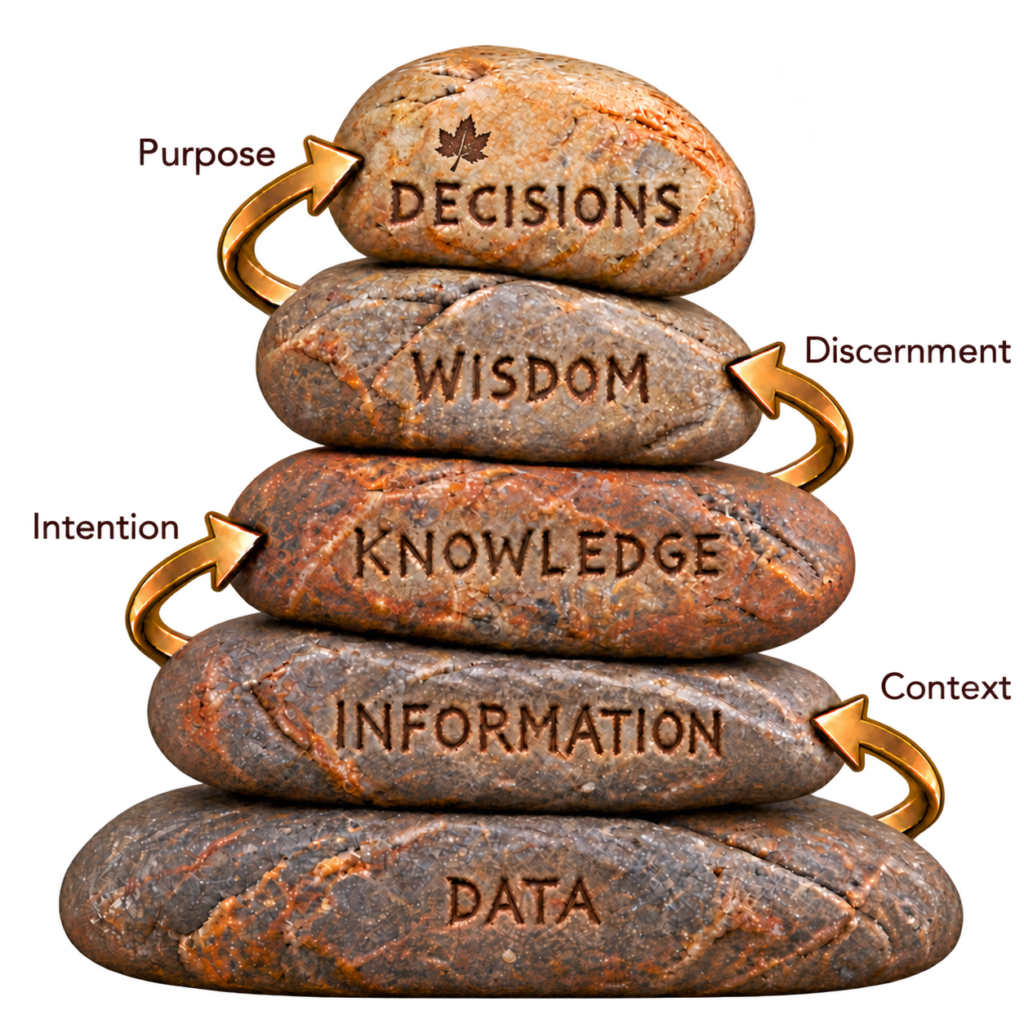
From data to decisions.
Adapted from Figure 18 in Eduardo Trauer’s doctoral thesis (2021, p. 78), based on Mazzetto et al. (2019). Image generated using ChatGPT (OpenAI), under the direction and review of Eduardo Trauer (2026).
EDUARDO TRAUER · KNOWLEDGE & RESEARCH
Knowledge in action
Schreiber and colleagues describe knowledge in relation to the practical use of data and information: people draw on what they know to carry out tasks and create further information (Schreiber et al., 2000, as cited in Trauer, 2021, p. 26).
This perspective directs attention to what someone can do with information. A temperature reading, for example, becomes useful to a coffee roaster when it can be interpreted in relation to the beans, the equipment and the intended result. This example illustrates the perspective rather than reproducing a definition proposed by those authors.
Sharif brings context and reasoning into this discussion. Representing informational content is insufficient if its meaning cannot be understood within the situation in which it will be used (Sharif, 2004, as cited in Trauer, 2021, p. 31).
For research and practice, this raises a question: what must a person understand to use an available piece of information appropriately?
Tacit and explicit knowledge
Explicit knowledge is knowledge that can be articulated, recorded and communicated systematically. Manuals and written procedures are examples: they make an explanation or a way of performing a task available for others to consult and use. This is the form of knowledge associated with manuals and procedures in my thesis’s discussion of Nonaka and Takeuchi (1995, as cited in Trauer, 2021, p. 291).
Tacit knowledge is rooted in personal experience and practical judgement, and is difficult to express fully in words or instructions. In the same discussion, it is associated with learning through experience and with indirect forms of sharing, such as metaphors and analogies (Nonaka & Takeuchi, 1995, as cited in Trauer, 2021, p. 291).
The authors also describe systemic knowledge as emerging through the aggregation of explicit knowledge (Nonaka & Takeuchi, 1995, as cited in Trauer, 2021, p. 291).
These distinctions help explain why access to documentation does not automatically produce expertise. A written description of a coffee’s sensory characteristics can guide attention, while recognising those characteristics also involves experience and judgement.
Polanyi’s discussion of the tacit dimension draws attention to the limits of what people can articulate about what they know. Sharif likewise recognises that aspects of human knowledge may not always be consciously available (Polanyi, 2013, as cited in Trauer, 2021, p. 291; Sharif, 2004, as cited in Trauer, 2021, p. 291).
This matters when working with domain experts. An explanation is a valuable contribution, but it should not be mistaken for an exhaustive account of everything that enables a person to act skilfully.
Representing knowledge so that it can be shared
Making knowledge accessible involves choices about what to represent and how. In the account of Brachman and Levesque discussed in my thesis, formal symbols represent propositions held by an agent. Any representation captures a selection of those propositions, rather than everything the agent might know (Brachman & Levesque, 2009, as cited in Trauer, 2021, p. 76).
Almeida describes the knowledge engineer’s task in terms of formalising the knowledge of a group of specialists. Silva and Spitz emphasise identifying and codifying aspects of organisational knowledge so that others can access them (Almeida, 2014, as cited in Trauer, 2021, p. 77; Silva & Spitz, 2007, as cited in Trauer, 2021, p. 77).
The challenge is to retain what makes that knowledge useful. Loureiro addresses the difficulty of making knowledge explicit without losing its distinctive properties. Ceci focuses on representing acquired knowledge so that it can be used, shared and reused (Loureiro, 2003, as cited in Trauer, 2021, p. 77; Ceci, 2010, as cited in Trauer, 2021, p. 77).
In my research, ontologies, knowledge graphs and the k-SCAS framework served this purpose: they made selected knowledge and relationships visible. Their value depended on helping people understand a system and recognise connections beyond their own stage of activity.
A collectively developed metaconcept
The metaconcept adopted in my doctoral thesis emerged from collective discussions among faculty members of the Postgraduate Programme in Engineering and Knowledge Management (PPGEGC) at the Federal University of Santa Catarina. Pacheco’s publication is the bibliographic source through which this collectively developed formulation is presented in the thesis.
In English, the formulation adopted in my thesis describes knowledge as content or process enacted by human or artificial agents in activities that generate scientific, economic, social and/or cultural value (Pacheco, 2016, as cited in Trauer, 2021, p. 43).
This formulation brings together several dimensions: what knowledge consists of, how it takes place, which agents participate and what forms of value their activities generate.
The wording deserves a clarification. In the Portuguese transcription in my thesis, I added the bracketed conjunction in “social [e]/ou cultural” and discussed this intervention with Pacheco. The addition makes explicit that these forms of value may coexist. It is my intervention in the transcription; the underlying metaconcept remains a contribution of the programme’s collective intellectual work.
The framework reproduced in the thesis considers three perspectives on knowledge:
- Cognitivist: knowledge is approached in relation to content, humans and machines, including processes and products through which value is generated.
- Autopoietic: the emphasis falls on knowledge as a process, with attention to human agents and knowing.
- Connectionist: the emphasis falls on collectives, communication and relationships, with knowledge understood through encounters among human and non-human actants that generate value.
These are complementary perspectives within the account adopted in the thesis. Their comparison informed the metaconcept used to guide the k-SCAS framework (Trauer, 2021, pp. 96–97).
Knowledge and the creation of value
The conception of knowledge as a factor that generates value also appears in the work of Pacheco, Freire and Tosta discussed in my thesis (Pacheco et al., 2011, as cited in Trauer, 2021, p. 32).
Within the specialty coffee system, this led me to define essential knowledge in relation to what actors need to obtain and maintain the highest quality at the stage in which they participate. Essential knowledge is therefore a situated definition: it connects knowledge to particular actors, activities and purposes (Trauer, 2021, pp. 29, 42, 148).
I distinguished this term from critical knowledge. The literature discussed in the thesis assesses criticality through factors grouped around rarity, utility, difficulty of capture and the nature of knowledge. Those criteria were not investigated in my survey, so its findings were described as essential knowledge (Ermine et al., 2006, as cited in Trauer, 2021, p. 148; Fraga, 2019, as cited in Trauer, 2021, p. 148).
This distinction matters beyond coffee. Knowledge can be important for a decision without having been assessed against the specific criteria required to classify it as critical.
Questions that continue into my research
During the examination of my doctoral thesis, the application of proto-personas in marketing was highlighted by the examining committee as a contribution of the research. Professor Luciana Florêncio de Almeida, then a postgraduate coordinator at ESPM in São Paulo, drew particular attention to this contribution.
This contribution became a starting point for my subsequent research. The perspectives on knowledge explored here continue to inform my work on proto-personas for knowledge-intensive markets through knowledge co-creation between domain experts and generative AI.
They direct attention to whose knowledge is being represented, which context gives it meaning and how an interpretation can be traced back to its sources. They also encourage care when moving between an expert’s experience, a recorded explanation and an AI-generated response. Each involves different forms of mediation and requires scrutiny.
In this research agenda, the collective metaconcept provides a way to examine the participation of human and artificial agents without treating every generated output as established knowledge. The question remains how those contributions support understanding and the creation of value.
For EdoMind, these questions connect the study of knowledge to practical decisions in research, teaching and marketing:
What do we need to understand before deciding how to act?
Further conceptual connections
From data to knowledge. The thesis draws on classroom discussions with Todesco and Gonçalves and on Mazzetto and colleagues to relate interpretation, the elaboration of information and learning to knowledge acquisition. The pathway from data towards decisions is also represented visually in the thesis (Trauer, 2021, pp. 26, 78).
Codification and its limits. The discussion of Schultze and Leidner, reported through Alves, relates codification to the possibility of making memory and communication less dependent on individual knowledge holders. This account should be considered alongside the limits of articulating tacit knowledge, rather than read as a claim that all expertise can be extracted from a person (Trauer, 2021, p. 77).
Knowledge as an organisational and productive resource. Schreiber and colleagues connect knowledge to organisational competitiveness, while Rao discusses its increasing importance as a factor of production in agriculture (Schreiber et al., 2000, as cited in Trauer, 2021, p. 79; Rao, 2007, as cited in Trauer, 2021, p. 79).
Technological knowledge and know-how. The thesis examines Bunge’s account of technology as a field of knowledge concerned with artefacts, Mitcham’s distinction between technology as object, knowledge, activity and volition, and Cupani’s discussion of technical knowing. It also reproduces, through Cupani, Skolimowski’s account of technology as purposeful human knowledge and Jarvie’s emphasis on working knowledge or know-how. These are situated accounts of technology that draw on knowledge, rather than general definitions of knowledge itself (Trauer, 2021, pp. 100–102).
Knowledge for designing and improving. Drawing on Burgoyne and James and on Lacerda and colleagues, the thesis distinguishes the descriptive character of the k-SCAS framework from the prescriptive knowledge that may emerge through its application. Representing a system and proposing ways to improve it are related research activities with different purposes (Trauer, 2021, pp. 98–99).
References
Primary source for this article
This article draws on the discussion of knowledge developed in my doctoral thesis.
Trauer, E. (2021). k-SCAS: Framework do sistema de agronegócios de cafés especiais orientado ao conhecimento [Doctoral dissertation, Universidade Federal de Santa Catarina]. Repositório Institucional da UFSC. https://repositorio.ufsc.br/handle/123456789/227021
References used in the thesis and revisited in this article
The following works informed the theoretical discussion in my thesis and are revisited here through that discussion. Secondary citations identify the original authors and the corresponding passages in the thesis.
Almeida, M. B. (2014). Uma abordagem integrada sobre ontologias: Ciência da Informação, Ciência da Computação e Filosofia. Perspectivas em Ciência da Informação, 19(3), 242–258. https://doi.org/10.1590/1981-5344/1736
Alves, L. E. F. (2005). O compartilhamento do conhecimento nas organizações: Um estudo desconstrucionista [Master’s dissertation, Fundação Getulio Vargas]. Repositório Institucional da FGV. https://hdl.handle.net/10438/3877
Brachman, R. J., & Levesque, H. J. (2009). Knowledge representation and reasoning. Elsevier.
Bunge, M. (1985). Treatise on basic philosophy: Vol. 7. Epistemology & methodology III: Philosophy of science and technology. Part II: Life science, social science and technology. D. Reidel.
Burgoyne, J., & James, K. T. (2006). Towards best or better practice in corporate leadership development: Operational issues in Mode 2 and design science research. British Journal of Management, 17(4), 303–316. https://doi.org/10.1111/j.1467-8551.2005.00468.x
Ceci, F. (2010). Um modelo semi-automático para a construção e manutenção de ontologias a partir de bases de documentos não estruturados [Master’s dissertation, Universidade Federal de Santa Catarina].
Cupani, A. (2016). Filosofia da tecnologia: Um convite. Editora da UFSC.
Ermine, J.-L., Boughzala, I., & Tounkara, T. (2006). Critical knowledge map as a decision tool for knowledge transfer actions. Electronic Journal of Knowledge Management, 4(2), 129–140.
Fraga, B. D. (2019). Framework de análise de conhecimentos críticos às capacidades de resiliência organizacional [Doctoral dissertation, Universidade Federal de Santa Catarina]. Repositório Institucional da UFSC. https://repositorio.ufsc.br/handle/123456789/214893
Lacerda, D. P., Dresch, A., Proença, A., & Antunes Júnior, J. A. V. (2013). Design Science Research: Método de pesquisa para a engenharia de produção. Gestão & Produção, 20(4), 741–761. https://doi.org/10.1590/S0104-530X2013005000014
Loureiro, J. L. (2003). Gestão do conhecimento. Centro Atlântico.
Mazzetto, F., Gallo, R., Riedl, M., & Sacco, P. (2019). Proposal of an ontological approach to design and analyse farm information systems to support Precision Agriculture techniques. IOP Conference Series: Earth and Environmental Science, 275(1), Article 012008. https://doi.org/10.1088/1755-1315/275/1/012008
Mitcham, C. (1994). Thinking through technology: The path between engineering and philosophy. University of Chicago Press.
Nonaka, I., & Takeuchi, H. (1995). The knowledge-creating company: How Japanese companies create the dynamics of innovation. Oxford University Press. https://doi.org/10.1093/oso/9780195092691.001.0001
Pacheco, R. C. S. (2016). Coprodução em ciência, tecnologia e inovação: Fundamentos e visões. In J. M. Pedro & P. S. Freire (Eds.), Interdisciplinaridade: Universidade e inovação social e tecnológica (pp. 21–62). CRV.
Pacheco, R. C. S., Freire, P. S., & Tosta, K. C. B. T. (2011). Experiência multi e interdisciplinar do Programa de Pós-Graduação em Engenharia e Gestão do Conhecimento da UFSC. In A. Philippi Jr. & A. J. Silva Neto (Eds.), Interdisciplinaridade em ciência, tecnologia & inovação. Manole.
Polanyi, M. (2013). The tacit dimension. University of Chicago Press.
Rao, N. H. (2007). A framework for implementing information and communication technologies in agricultural development in India. Technological Forecasting and Social Change, 74(4), 491–518.
Schreiber, G., Akkermans, H., Anjewierden, A., de Hoog, R., Shadbolt, N. R., Van de Velde, W., & Wielinga, B. J. (2000). Knowledge engineering and management: The CommonKADS methodology. MIT Press.
Schultze, U., & Leidner, D. E. (2002). Studying knowledge management in information systems research: Discourses and theoretical assumptions. MIS Quarterly, 26(3), 213–242. https://doi.org/10.2307/4132331
Sharif, A. M. (2004). Knowledge representation within information systems in manufacturing environments [Doctoral dissertation, Brunel University]. Brunel University Research Archive. https://bura.brunel.ac.uk/handle/2438/2455
Silva, I., & Spitz, R. (2007). A gestão do conhecimento organizacional e sua relação com a vantagem competitiva. Universidad de Palermo.
Cite this article
ABNT
TRAUER, Eduardo. What is knowledge? EdoMind, 15 out. 2026. Disponível em: https://edomind.com/what-is-knowledge/. Acesso em: dd mm yyyy.
APA
Trauer, E. (2026, October 15). What is knowledge? EdoMind. https://edomind.com/what-is-knowledge/
Harvard
Trauer, E. 2026. What is knowledge? [Online]. [Accessed dd mm yyyy]. Available from: https://edomind.com/what-is-knowledge/
Thesis details
Author: Eduardo Trauer
Original title: k-SCAS: framework do sistema de agronegócios de cafés especiais orientado ao conhecimento
Document type: PhD Thesis
Degree: PhD in Engineering and Knowledge Management
Institution: Federal University of Santa Catarina — UFSC
Programme: Postgraduate Programme in Engineering and Knowledge Management
Supervisor: Prof. Dr Eduardo Moreira da Costa
Co-supervisor: Prof. Dr José Leomar Todesco
Place and year: Florianópolis, Brazil · 2021
Extent: 304 pages
Language: Portuguese
Award: Best Thesis in Knowledge Engineering — awarded by the Postgraduate Programme in Knowledge Engineering, Management and Media, UFSC, in 2022.
KNOWLEDGE · CONCEPTS & PERSPECTIVES
Knowledge, understanding and the value we create
The perspectives explored here invite us to understand knowledge through action, experience, representation and the relationships through which it creates value. Each offers a way to consider what we know, how we share it and how it informs our decisions.
The metaconcept collectively developed by the faculty of PPGEGC/UFSC brings these concerns together, recognising the participation of human and artificial agents in activities that generate scientific, economic, social and cultural value.
From the specialty coffee system to my research on proto-personas in knowledge-intensive markets, these questions continue to guide my work: whose knowledge matters, how can it be represented, and what understanding can emerge when different perspectives meet?
Knowledge at the heart of understanding, co-creation and strategic decisions.
Reflections drawn from Eduardo Trauer’s doctoral thesis, defended at the Federal University of Santa Catarina in 2021.