
EDOMIND / LIFE STUDIO / BONSAI IN FLORIANÓPOLIS
Bonsai in Florianópolis
Nature, Culture and a Growing Community
SECOND FLORIANÓPOLIS BONSAI EXHIBITION
Cultivating a community
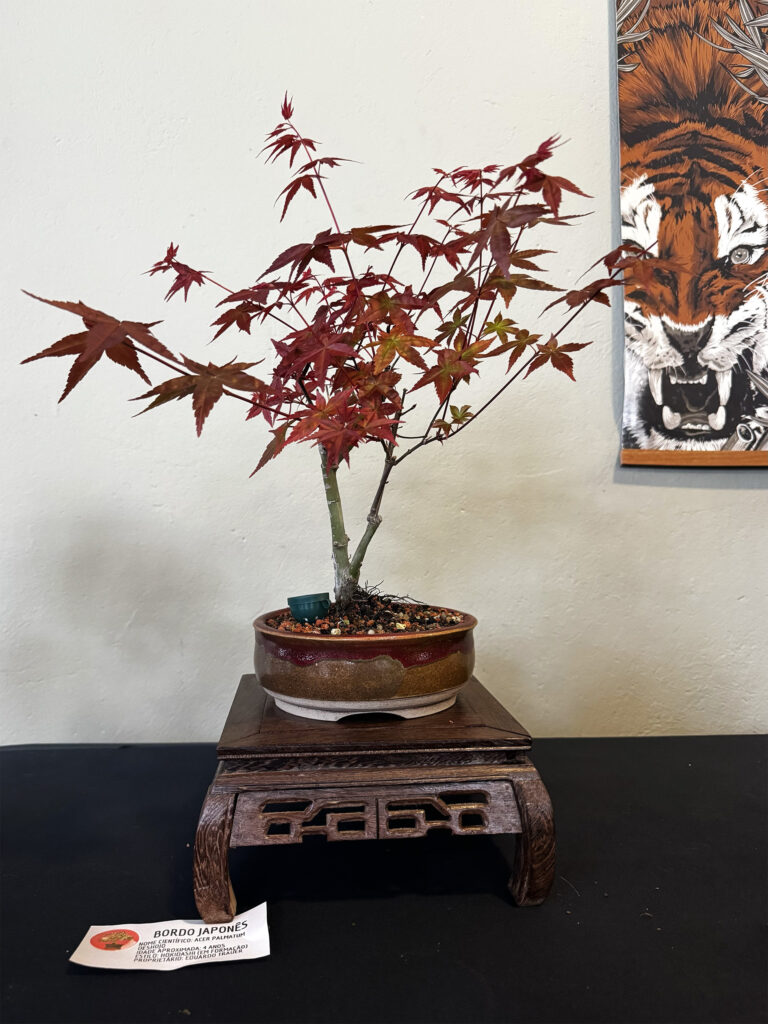
The opening of the second Florianópolis Bonsai Exhibition, held at the city’s Botanical Garden Park, introduced a vision that extends beyond admiring trees: strengthening a community, sharing knowledge and bringing people closer to nature through art and Japanese culture.
Florianópolis, 10 October 2026
Second Florianópolis Bonsai Exhibition
The opening of the second Florianópolis Bonsai Exhibition, held at the city’s Botanical Garden Park, introduced a vision that extends beyond admiring trees: strengthening a community, sharing knowledge and bringing people closer to nature through art and Japanese culture.
Conceived by bonsai practitioners Odilon Faccio and Márcio Misso, the exhibition reflects their commitment to developing bonsai in Florianópolis. Their opening remarks highlighted progress since the first edition, both in the quality of the trees displayed and in the expansion of educational activities. Continuous improvement was a guiding principle: each exhibition offers an opportunity to learn, refine the work and welcome new participants.
Faccio and Misso also described the event as the result of personal dedication, financial commitment and institutional collaboration. They acknowledged the support of the Botanical Garden, the municipal government and the Municipal Department of the Environment, alongside the involvement of the Friends of the Botanical Garden Association, Nipocultura and the Nipo-Catarinense Association. These partnerships bring people and organisations together around a shared purpose: sustaining the practice and appreciation of bonsai in the city.
One of the most compelling themes of the opening was the relationship between bonsai and Japanese culture. In his address, the Nipocultura representative expressed the view that Japanese culture cannot be separated from nature. Bonsai was presented as an expression of this connection: a way of developing intimacy, care and affection towards the natural world.
This interpretation was enriched by a comparison with haiku. The speaker highlighted the presence of the seasons in this poetic form through kigo, the seasonal reference that connects a poem to nature’s cycles. He also drew a parallel between the concision of haiku and miniaturisation in bonsai: just as a few words can convey a much broader experience, a tree cultivated on a small scale can evoke a landscape and bring the experience of nature closer.
In the interpretation offered during the address, bonsai and haiku share an ability to distil meaning. Their small scale does not diminish what they represent; it focuses attention and encourages a more intimate encounter with forms, details and changes that might otherwise go unnoticed. Bonsai thus emerges as both an artistic expression and a bridge between cultures.
Education was another central theme. Faccio and Misso identified two audiences: those approaching bonsai out of curiosity, with basic questions still to explore, and those who already cultivate trees and seek to deepen their understanding and refine their practice.
For beginners, the organisers introduced learning resources covering the selection of plant material, initial styling, bonsai styles and pot selection. The opening remarks also referred to free lessons, PDF materials and video content as opportunities to continue learning beyond the exhibition. For more experienced practitioners, the announced programme included demonstrations and presentations by professionals with training and experience in Brazil and abroad.
Connections with other cultural and artistic practices were also part of the programme. The organisers announced a discussion linking bonsai and aikido through their principles, symbols and purposes, alongside a presentation on the cascade style. Together, these activities brought cultivation, philosophy and artistic creation into dialogue.
The association representatives emphasised the importance of learning before teaching and seeking guidance to care for trees properly. Shared knowledge was presented as a way to prevent difficulties in cultivation and provide continuing support for those beginning their bonsai journey.
For the Friends of the Botanical Garden Association, initiatives such as this contribute to a park that brings together conservation, plant collections and cultural activities. The exhibition supports this vision of a living public space shaped by community participation.
Looking ahead, Faccio and Misso expressed their ambition for the Botanical Garden to become a centre for bonsai in Santa Catarina, fostering exchange with other cities and regions. They presented continuity as a commitment extending beyond the organisers themselves: creating opportunities for others to participate, learn and take on new roles.
More than a gathering of trees for contemplation, the second exhibition revealed a shared endeavour built on encounters and the passing on of knowledge. An invitation to cultivate bonsai—and, through it, a more attentive relationship with nature, culture and the city.
BONSAI, HAIKU AND JAPANESE CULTURE
Nature expressed on a small scale
During the opening address, the Nipocultura representative drew a connection between bonsai, Japanese culture and an attentive relationship with nature.
He compared bonsai with haiku, a concise poetic form in which a few words can evoke a much broader experience. Through kigo—a seasonal reference—a haiku connects that experience to the rhythms of the natural world.
In the parallel presented by the speaker, a small tree can evoke an entire landscape, just as a short poem can suggest a wider world. Their compact form focuses our attention on details, seasons and changes, encouraging a closer relationship with nature.
A small tree, a few words, a wider world.
Reflection based on the opening address at the Second Florianópolis Bonsai Exhibition, 10 October 2026.