
EDOMIND / LIFE STUDIO / WHEN THE WEST BEGAN TO LOOK AT BONSAI
When the West Began
to Look at Bonsai
From nineteenth-century publications and exhibitions
to Albert Maumené’s landmark book of 1902.
THE WESTERN ENCOUNTER WITH BONSAI
An ancient tree in a small pot
By Eduardo Trauer · Published on 2 November 2026
An ancient tree, cultivated in a small pot, posed a question for nineteenth-century European observers: how could such longevity be reconciled with such small dimensions?
NINETEENTH-CENTURY ENCOUNTERS
Between admiration and misunderstanding
TEXTS FROM THAT PERIOD record admiration for the skill of Japanese growers, uncertainty about their methods, and judgements that reveal the difficulty of understanding an unfamiliar aesthetic. Western engagement with bonsai developed through this encounter between what observers could see and what their existing knowledge allowed them to explain.
Published in Paris in 1902, Albert Maumené’s Les arbres nains japonais occupies an important place in this history. It brought together knowledge, descriptions and interpretations already circulating in European publications, organising them into a book devoted entirely to the subject.
Before the Book: Images, Accounts and Trees on Display
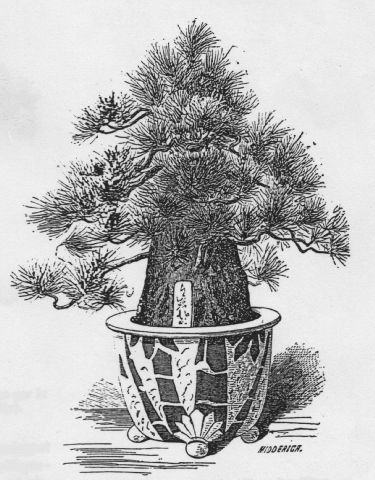
In 1874, Élie-Abel Carrière published “Un grand arbre nanisé” in Revue horticole. The article featured a drawing based on a photograph of a pine cultivated in Shiba, Japan, described in the accompanying account as more than a century old. The small container, the proportions of the trunk and the care required to sustain the tree prompted questions and recognition of the growers’ skill (Carrière, 1874).
This account shows that information about miniature Japanese trees was reaching European readers before the major exhibitions that would increase their visibility.
At the Paris Universal Exhibition of 1878, living specimens offered another opportunity for contact. Carrière examined the plants and published “Essai sur l’horticulture japonaise,” accompanied by illustrations. He sought to explain how Japanese gardeners achieved these forms, acknowledging that some of his interpretations remained hypothetical (Carrière, 1878).
Another Paris exhibition renewed this interest in 1889. In “Japonaiseries,” Carrière compared trees displayed that year with specimens shown in 1878. He described conifers, exposed roots and miniature landscapes, recognising that the results required knowledge and attentive care extending beyond patience alone (Carrière, 1889).
These episodes document a stage in European engagement with bonsai. They do not establish a single date for its arrival in the West, a process involving different people, publications and routes of exchange.
Between Admiration and Unease
European responses were far from uniform.
In 1878, C. W. Quin published “The horticultural comprachicos of Japan at the Paris Exhibition” in the British magazine The Garden. The title invoked Victor Hugo’s comprachicos, associated with the deliberate deformation of human bodies. By applying this comparison to trees, Quin expressed a strongly negative judgement of Japanese cultivation practices (Quin, 1878).
The article reveals the cultural distance involved in this encounter. A tree could inspire admiration for its age while provoking rejection of its form. Observers interpreted what they saw through their own assumptions about nature, beauty and cultivation.
Terms such as “deformation” and “monstrosity,” found in this literature, therefore require historical context. They reveal the values of the writers as well as their perceptions of the trees.
From Hypotheses to Dialogue with Growers
In 1889, miniature Japanese trees also became a subject of discussion at the Société botanique de France.
Joseph Vallot attempted to explain their small dimensions and unusual forms by relating them to his observations of conifers in mountain environments. His paper examined the possible effects of damage to the main stem, root restrictions and growing conditions (Vallot, 1889).
At the same meeting, Paul Maury presented information obtained from Japanese interlocutors associated with the exhibition. His account compared some European hypotheses with the practices described to him, challenging aspects of earlier explanations (Maury, 1889).
Together, these papers document knowledge taking shape through observation, proposed explanations, consultation with practitioners and debate. They also record disagreement. Their explanations should consequently be understood as historical accounts rather than assumed to represent current horticultural knowledge.
1902: A Milestone in Western Bonsai Literature
It was against this background that Albert Maumené published Les arbres nains japonais: Leur formation au Japon, leur utilisation et leur traitement en Europe.
Bonsai historian Robert J. Baran (n.d.) identifies it as the earliest known work in a European language devoted entirely to bonsai. This distinction supports its recognition as a publishing milestone in the Western dissemination of the art.
The subtitle makes its purpose clear: to discuss the formation of these trees in Japan and their use and care in Europe. Illustrated with 16 engravings, the book addresses three broad areas (Maumené, 1902).
Aesthetics, forms and landscapes. The first chapter considers the appearance of the trees, their classification, suitable species and miniature landscapes. It also discusses growers and the transmission of trees across generations.
Methods of formation. The second chapter describes practices attributed to Japanese growers, including raising trees from seed, training branches, working with roots, shaping older trees and grafting. These descriptions preserve a mixture of reported practices and interpretations that need to be assessed in their historical context.
Keeping trees in Europe. The third chapter addresses pruning, repotting, fertilisation and winter protection. Maumené also identifies a misconception: treating these trees as plants intended to remain permanently indoors. For most of the specimens discussed, he recommends outdoor conditions, with temporary indoor display.
The significance of the book lies in this combination of aesthetic consideration, attempted explanation and practical care. Readers encountered an organised, illustrated treatment of the subject that also addressed the challenge of keeping the trees alive.
A Collaboration with Time
One idea in Maumené’s book remains particularly evocative. Discussing trees passed down through generations, he presents them as the products of collaboration between human beings and time (Maumené, 1902).
Read today, this observation connects the history of publishing with the experience of cultivation. Each tree carries decisions, care and transformations accumulated beyond a single gesture or a single person.
Nineteenth-century publications recorded questions and encounters. Maumené’s book gave this interest a dedicated publishing form at the beginning of the twentieth century. Revisiting these pages allows us to follow how bonsai was described and interpreted for new audiences—and to recognise that learning to look was itself part of that history.
References
Baran, R. J. (n.d.). Albert Maumené’s Les arbres nains japonais (1902). Magical Miniature Landscapes. Retrieved November 2, 2026, from https://www.magiminiland.org/Books/Maumene/Covers.htm
Carrière, E.-A. (1874). Un grand arbre nanisé [A large dwarfed tree]. Revue horticole, 46, 272–273. Retrieved November 2, 2026, from https://www.magiminiland.org/1800Refs/ArbreNanise.html
Carrière, E.-A. (1878). Essai sur l’horticulture japonaise [Essay on Japanese horticulture]. Revue horticole, 50, 271–275. Retrieved November 2, 2026, from https://www.magiminiland.org/1800Refs/Essai1878.html
Carrière, E.-A. (1889). Japonaiseries [Japanese curiosities]. Revue horticole, 61, 374–378. Retrieved November 2, 2026, from https://www.magiminiland.org/1800Refs/Japonaiseries.html
Maumené, A. (1902). Les arbres nains japonais: Leur formation au Japon, leur utilisation et leur traitement en Europe [Japanese dwarf trees: Their formation in Japan, their use and care in Europe]. Librairie horticole; L’Art Nouveau Bing; François Tedesco. Retrieved November 2, 2026, from https://www.magiminiland.org/Books/Maumene/Fr_Intro.html
Maury, P. (1889). Sur les procédés employés par les Japonais pour obtenir des arbres nains [On the methods used by the Japanese to produce dwarf trees]. Bulletin de la Société botanique de France, 36, 290–294. Retrieved November 2, 2026, from https://doi.org/10.1080/00378941.1889.10830461
Quin, C. W. (1878, August 24). The horticultural comprachicos of Japan at the Paris Exhibition. The Garden, 14, 174–175. Retrieved November 2, 2026, from https://www.magiminiland.org/1800Refs/Quin.html
Vallot, J. (1889). Causes physiologiques qui produisent le rabougrissement des arbres des cultures japonaises [Physiological causes of stunted growth in trees cultivated by the Japanese]. Bulletin de la Société botanique de France, 36, 284–289. Retrieved November 2, 2026, from https://doi.org/10.1080/00378941.1889.10830460
Source note. Carrière’s and Quin’s articles were consulted through digital reproductions containing transcriptions and illustrations assembled by Robert J. Baran. Vallot’s and Maury’s papers were consulted as digitised journal pages. The identification of Maumené’s publishing precedence follows Baran’s historical account. English translations of French titles in the reference list are provided for readers’ convenience.
Cite this article
ABNT
TRAUER, Eduardo. When the West Began to Look at Bonsai. EdoMind, 2 Nov. 2026. Available at: https://edomind.com/when-the-west-began-to-look-at-bonsai/. Accessed on: [day month year].
APA
Trauer, E. (2026, November 2). When the West began to look at bonsai. EdoMind. https://edomind.com/when-the-west-began-to-look-at-bonsai/
Harvard
Trauer, E. (2026) ‘When the West began to look at bonsai’, EdoMind, 2 November. Available at: https://edomind.com/when-the-west-began-to-look-at-bonsai/ (Accessed: [day month year]).
BONSAI, TIME AND CONTINUITY
Learning to look, learning to care
The history of bonsai in the West invites us to consider how we approach what is unfamiliar. Looking closely is a beginning; understanding also asks us to question our assumptions and listen to those who cultivate.
A living tree asks for attention, knowledge and continuity of care. Its form changes with the seasons and with the decisions of successive growers.
To cultivate bonsai is to participate in a process that extends beyond a single moment. We receive something already in motion and help shape what comes next.
A living tree, generations of care.
An editorial reflection by Eduardo Trauer, inspired by the historical sources discussed in this article.